
When most business owners hear “Balance Sheet”, they mentally switch off. Too many terms. Too many numbers. Too confusing. Let’s fix that.
A Balance Sheet is simply: A snapshot of what your business owns and what it owes — at a specific date. That’s it. Not a mystery. Not magic. Just a financial photograph.
Think of It Like This Imagine you pause your business today.You list:
- Everything you own
- Everything you owe
- What’s left for you
That list is your Balance Sheet.
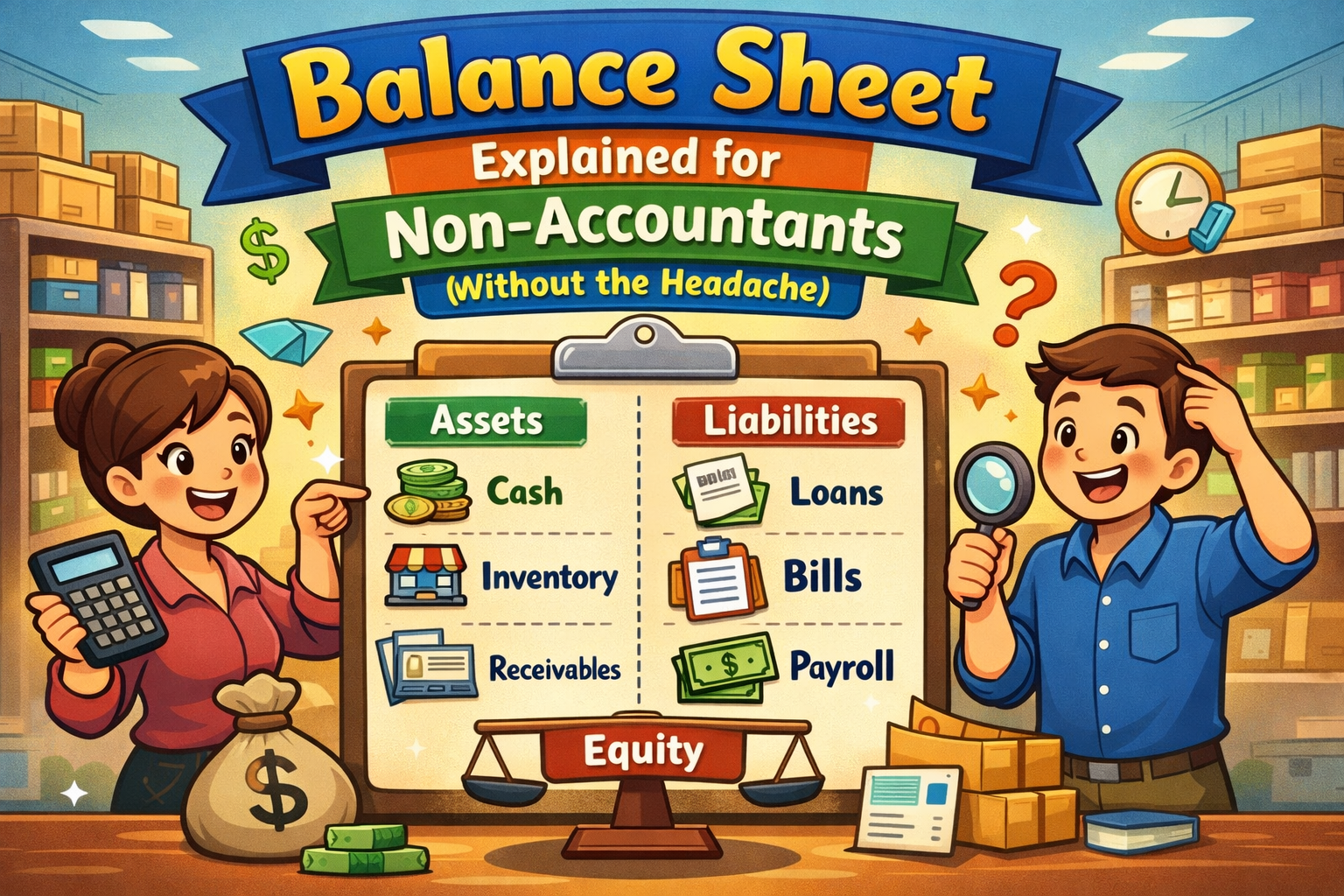
The Basic Formula (Don’t Panic) : Every Balance Sheet follows one rule: Assets = Liabilities + Equity. It looks technical. It’s not. Let’s translate it into normal language. Assets – What You Own: Assets are things your business has that hold value. Examples:
- Cash in bank
- Cash in hand
- Inventory (goods in stock)
- Furniture
- Computers
- Vehicles
- Money customers owe you
If it belongs to your business and has value — it’s an asset. Example: Cash: 100,000, Inventory: 200,000, Furniture: 50,000 Total Assets = 350,000 Simple.
Liabilities – What You Owe: Liabilities are debts or obligations. Examples:
- Bank loan
- Supplier payments due
- Unpaid rent
- Unpaid salary
- Tax payable
If you owe someone money — it’s a liability. Example:
- Supplier payable: 80,000
- Bank loan: 70,000
Total Liabilities = 150,000
Equity – What’s Actually Yours : Equity is what belongs to the owner after debts are cleared. Formula: Equity = Assets – Liabilities Using our example: 350,000 – 150,000 = 200,000 That 200,000 is your ownership value in the business. If you sold everything and paid all debts, that’s what you’d roughly walk away with. That’s equity.
Simple Balance Sheet Example (Let’s structure it clearly)
Balance Sheet as of January 31
Assets
- Cash: 100,000
- Inventory: 200,000
- Furniture: 50,000
Total Assets = 350,000
Liabilities
- Supplier Payable: 80,000
- Bank Loan: 70,000
Total Liabilities = 150,000
Equity
- Owner’s Capital: 200,000
Total Liabilities + Equity = 350,000 See? It balances. That’s why it’s called a Balance Sheet.
Why the Balance Sheet Matters (In Real Life)
Most business owners only look at Profit & Loss. Big mistake. The Balance Sheet tells you:
- Are you overloaded with debt?
- Are customers delaying payments?
- Is your inventory stuck?
- Is your business actually growing in value?
- Are you financially stable?
Your P&L shows performance. Your Balance Sheet shows stability. You need both.
Common Misunderstandings – “If I have cash, I’m doing well.” Not necessarily. You might:
- Owe suppliers
- Owe tax
- Have big loans
Balance Sheet shows the full picture.
“Profit means I’m rich.” No. You can make profit but:
- Customers haven’t paid you yet
- You reinvested in inventory
- You bought assets
That affects your Balance Sheet.
Think of It This Way. If Profit & Loss is: Your movie performance this month. Then Balance Sheet is: Your total net worth right now. One shows movement. One shows position.
When Should You Check It? At least: Monthly. Because small problems show up early:
- Growing debt
- Increasing payables
- Shrinking cash
- Inventory piling up
If you wait yearly, it’s already damage control.
Manual vs Software: You can create Balance Sheet manually in Excel.But problems:
- Easy to mismatch totals
- Easy to forget entries
- Hard to track changes
- Time consuming
With accounting software like ZUPO:
- It’s auto-generated
- Always balanced
- Linked with P&L
- Real-time
No stress. No broken formulas. No guessing.
Final Thought (Very Important): The Balance Sheet is not for accountants. It’s for owners. If you don’t understand your Balance Sheet, you don’t fully understand your business. And once you understand it, you stop making emotional decisions and start making strategic ones. That’s the difference between running a business… and building one.